
English Speaking Practice: 10 Exercises You Can Do Today
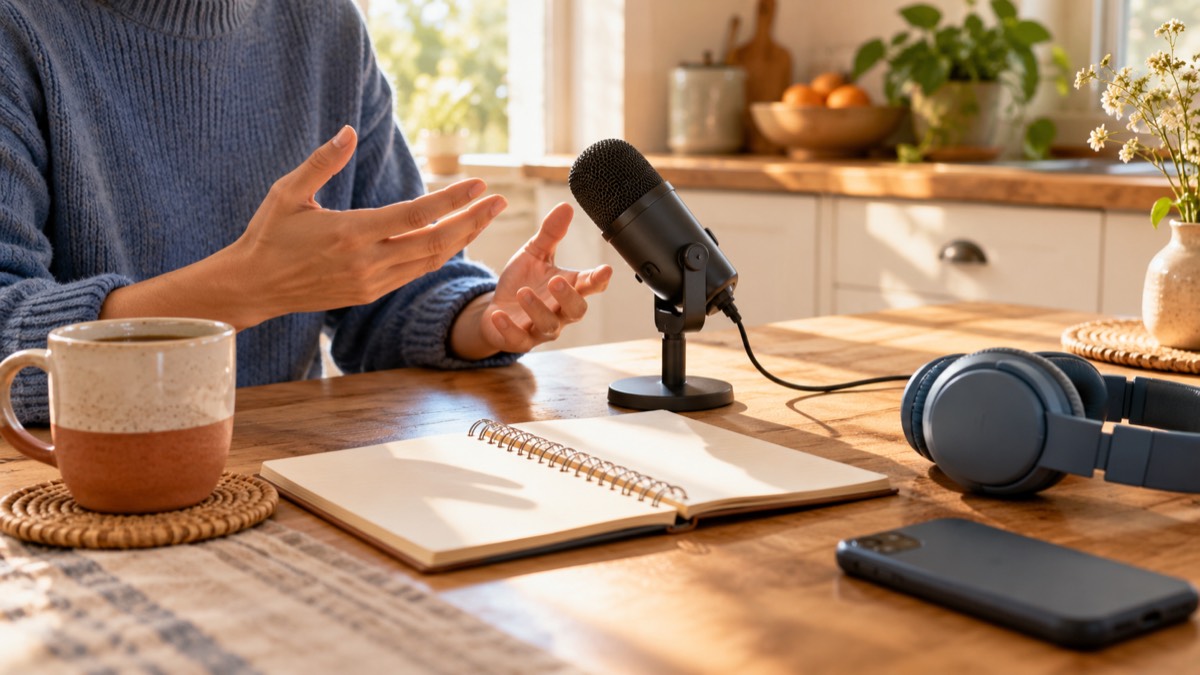
The most useful English speaking practice makes you produce language out loud, not just recognise it on a screen. Use short exercises such as one-minute descriptions, retelling, question drills, and role-plays, then repeat them often enough that common phrases come out without a long pause.
What counts as English speaking practice?
Speaking practice means your voice does the work. Reading a grammar explanation or watching a lesson can help, but neither gives you much practice choosing words quickly and saying them clearly.
You don't need a perfect partner or a two-hour lesson. A focused five-minute exercise is useful when it has a clear prompt, a time limit, and a second attempt. The second attempt matters because you can reuse better words instead of starting from zero.
1. Do a one-minute daily description
Choose something ordinary: your morning, your desk, your route to work, or what you cooked. Speak for one minute without stopping to write a script. If you forget a word, describe it another way and keep going.
- First round: speak freely for one minute.
- Second round: repeat it and add three details.
- Afterward: note one phrase you want to reuse tomorrow.
2. Retell something you just heard
Listen to a short English clip or read a short article. Put it away, then explain the main point in your own words. This exercise connects listening to speaking and shows whether you understood the idea, not just individual words.
Don't try to reproduce every sentence. Start with: The main idea is..., One example is..., and What surprised me was...
3. Answer the same question three ways
Pick a common question such as What did you do this weekend? Answer it once simply, once with more detail, and once as a short story with a beginning, middle, and end. The repetition gives you time to improve your grammar and vocabulary without changing the topic.
4. Practise useful conversation chunks
Store whole phrases rather than isolated words. Try I see what you mean, Let me think about that, It depends on the situation, or Could you say that again? Say each one in a sentence of your own. These chunks help you stay in a conversation while you decide what to say next.
5. Use a picture as a speaking prompt
Look at a photo and describe what you can see, what happened before the picture, and what might happen next. Then give your opinion. It is a simple way to practise description, past tense, future language, and reasons in one short session.
6. Turn a mistake into a second attempt
Record a short answer, listen once, and choose only one thing to improve. Maybe you repeated one word, used the wrong tense, or spoke too quietly. Record the same answer again with that one change. Trying to fix everything at once usually makes you stop speaking.
7. Practise a real-life role-play
Choose a situation you may actually face: ordering food, making small talk, explaining a problem at work, or asking for directions. Give yourself a goal, such as asking two follow-up questions. Realistic goals make practice easier to repeat than random word lists.
If you want a guided routine, our best way to practise English speaking guide explains how to build a weekly mix.
8. Shadow a short sentence
Play one sentence from clear English audio, pause, and copy its rhythm and pauses. Focus on the shape of the sentence rather than copying an accent. Then say the same idea with your own words. This links pronunciation practice to communication instead of making sound drills the whole session.
9. Ask follow-up questions
A conversation is not only about giving long answers. Take a simple statement such as I watched a film last night and ask three useful follow-ups: What was it about? Would you recommend it? What did you like? Practising questions helps you keep a conversation moving.
10. Follow a seven-day speaking plan
Give each day one small job: describe, retell, answer, role-play, shadow, ask questions, then repeat your favourite exercise. Keep a note of what felt easier and what still caused pauses. That record is more useful than guessing whether your English is improving.
For more short routines, see our daily English speaking practice page and our guide to English conversation practice.
How Rozy fits into speaking practice
Rozy gives you an AI English tutor to talk with at any time about real-life topics such as small talk, work, travel, family, shopping, music, and weather. You practise speaking out loud, receive instant feedback, and can see the corrected version of a grammar mistake with an explanation. Rozy also includes pronunciation practice with a score.
Rozy isn't for learners looking for a live human tutor, exam preparation, translation, or a certificate. It is free to download with in-app purchases, so it can be one part of a daily speaking routine.
Practising alone is easier when you have a topic and someone to respond. Rozy is an AI English tutor available 24/7 for spoken conversations about everyday situations. It gives instant grammar feedback, explains corrections, and includes pronunciation practice. It is not a human tutor, translator, exam-prep app, or certificate course.
Frequently asked questions
- How can I practise English speaking by myself?
- Use a prompt and speak out loud for one to five minutes. Describe your day, retell something you heard, answer a common question, or role-play a real situation. Record a second attempt and improve one thing.
- How many minutes of English speaking practice should I do?
- Start with five to ten focused minutes each day. Consistency matters more than one long session, because speaking improves through repeated attempts to produce language.
- Can I improve my spoken English without a speaking partner?
- Yes. Descriptions, retelling, shadowing, recordings, and role-plays all let you practise alone. A partner is still useful for unpredictable conversation, so add one when you can.
- What is the best exercise for English speaking practice?
- There isn't one exercise for every learner. A one-minute description is a good starting point because it builds fluency, vocabulary, and the habit of continuing after a small mistake.
- Should I correct every mistake while speaking?
- No. Choose one or two improvements after you finish. Constantly stopping to correct yourself can make you quieter and less fluent.
Related articles